
The exciting 1990s. End.
A year at the Center for Advanced Studies in Behavioral Sciences in Stanford.

In August 1998, the whole family took a plane to San Francisco where we would spend a sabbatical at the Center for Advanced Studies in Behavioral Sciences (CASBS) at Stanford University.
Things had not been obvious about this stay. Heddy was reluctant to leave and so was Florence. I thought the opportunity of learning English for the children was unique and that spending one year in the US would be enriching for the whole family. We had a family reunion with the 5 of us to try to come to a common agreement. At some point, we were near concluding that I would go with Elsa and Florence and Heddy would stay with Juliette when six-year-old Juliette spoke up and said: “We are not going to have the family divided for the whole year, are we?” and Heddy’s heart immediately melted. Juliette developed since an early age an uncanny talent for speaking her mind in public without fear, be it in her family, her extended family or in a very large audience.
We arrived in sunny San Francisco airport in late August 1998 after an uneventful flight (unlike our flight to Davis 7 years before; see https://gerardroland.substack.com/p/the-extraordinary-years-of-1989-1991-5d8 ). Our friend Bertrand from Davis came to pick us up with his van as we had brought luggage for the whole year. On top of that, our Burmese cat Mandarine came with us. We were renting the house of statistician David Siegmund on campus. The house was quite large and Elsa and Florence even had a television in their room where they gorged on episodes of “Friends” and music on MTV.
On that first day, after discovering the house we would live in for the year, I wanted to show them some of the specificities of the Bay Area weather. We drove from sunny Palo Alto towards the Pacific Ocean. As we crossed the hills facing the Pacific Ocean, we approached the small coastal city of Half Moon Bay totally covered in fog. During the Prohibition (1920-1933), bootleggers used it as a place to unload illegal liquor because of its heavy fog that made boats approaching the coast barely visible.
Elsa and Florence had been enrolled in Gunn high school to which they would bike everyday. Juliette got enrolled in Barron Park elementary school and entered her first year. The first day of school, instead of playing the “Star spangled banner”, they played “This land is your land” by Woody Guthrie. I realized then and saw it again many times when living in the US that for a large part of the US, Guthrie’s song was an alternative national hymn. Maybe one day, it could become the official national hymn.
The Center for Advanced Studies in Behavioral Sciences is located on a hill near Sand Hill Road, the legendary artery where many Silicon Valley firms are located. I biked there every day, but it was mostly uphill, especially the road leading to the center. The first few days, I was unable to bike all the way to the top, but after that it became a daily routine. The Center was composed of rectangular wooden boxes that served as offices and some central buildings for administration, seminars and lunches.
The Center is an interdisciplinary Research Institute founded in 1954. Fellows are selected from a large pool of applicants. Admitted fellows are supposed to spend a maximum of time at the Center to maximize the interactions with other researchers. Fellows were encouraged to have lunch together and to participate to the Wednesday evening seminars. Many even played volleyball after lunch, something I did not do as I felt blessed to have sufficient time on my hands to make progress on my research projects. I remember that my office had once been occupied by Ronald Coase (economics Nobel prize winner 1991). The Director of CASBS was famous sociologist Neil Smelser who had worked in particular on issues of collective behavior. James Scott (Seeing like a State) was also there that year. I also got to meet Arie Kruglanski, the famous psychologist from the University of Maryland. Laszlo Bruszt, the Hungarian sociologist I had already met at Collegium Budapest was also there as well as economists Paul Milgrom, John Shoven, E-Lu von Thadden and Erik Berglöf and political scientist Howard Rosenthal. Howard, Erik, E-Lu and I were part of a research project on the economics and political economy of bankruptcy law. E.Lu., Erik and I wrote a paper on the topic, but I spent most of my time writing my graduate textbook on the economics of transition. The setting was ideal for me and I was able to nearly finish the book by the time we returned to Europe.
I also participated regularly to the political economy seminars on Tuesday afternoon and Friday lunchtime and got to interact with local faculty like John Ferejohn or Barry Weingast. Ironically, I saw Yingyi less than I had imagined. Shortly after we arrived, he was denied tenure at the Stanford economics department and this was quite a traumatic event for him. He joined me later in Berkeley in September 2001 after spending a few years at Maryland University, but the tenure denial in Stanford left a deep scar in him, killing much of his enthusiasm for research. His talent would be put to use in Tsinghua University where he was Dean of the School of Economics and Management from 2006 to 2018. It was Zhu Rongji, himself former Dean of the Business School, who insisted that the job be given to Yingyi. As Dean he initiated many reforms at Tsinghua, but more on that later.
Heddy who had been reluctant to come spend a year in Stanford actually enjoyed herself thoroughly. She made friends at the SCRA (The Stanford Campus Recreation Association) sports club and swimming pool and elsewhere. We were there during the dotcom boom and the Stanford campus seemed very sleepy compared to the buzzing atmosphere outside campus and in the San Francisco peninsula. We made many friends and enjoyed the social life very much among the expats who had come to Silicon valley, attracted by the many possibilities it seemed to offer. The mother of one of Juliette’s friends at school for example was a good friend of Pierre Omidyar, the French software engineer who had created Ebay, initially to help his girlfriend buy online Pez dispensers that she was collecting, then becoming a multibillionaire. It was a time of great optimism where many things seemed possible. We spent many more evenings at parties than we ever had in Brussels and had lots of fun. The wonderful climate also offered so many outdoor activities and we toured California a lot. A memorable incident involved a bear breaking into our minivan at night at Yosemite national park, because little Juliette had left an empty bag of chips in the van. The trace of the bear’s paw was quite visible on the van’s door.
Everything was of course not so rose. I made many trips back and forth to Europe. During my first trip, shortly after we had arrived, I had to go to Berlin as I was the program Chairman of the Congress of the European Economic Association that took place at the end of August 1998. That is when the local organizers of the Congress offered me a piece of the Berlin wall that I have kept on my desk ever since. Unfortunately, during my trip to Berlin, my mother was diagnosed at the age of 69 with Horton’s disease, a dangerous autoimmune disease that can make people blind. The heavy cortisone treatment she had to take unfortunately had effects on her later health.
My brother Damien’s health was also a big concern. A few years earlier, he married in his late thirties Mieke, a woman he had been in love with 20 years before. They had bought a house together outside Mechelen and celebrated their wedding at a wild and memorable party at their property. What started off as an idyllic marriage started to sour after Mieke had a bad miscarriage when she was 6 months pregnant and would not be able to have children after that. Damien had always drunk a lot since he was young but his sudden sorrow triggered out of control drinking episodes. Mieke sent him to rehab a couple of times against his will and the marriage came to an end. His drinking problem then only got worse. In the morning, when I had biked up the hill to my office at CASBS, there were often worrying voicemails from Mieke or my father about Damien. I had been close to Damien all my life. This was all extremely worrying and I felt very helpless from the distance.
Our year in California ended with nice vacations in Hawai and Mexico. During a trip to Northern California to visit Heddy’s cousins in Santa Rosa, while crossing the Golden Gate Bridge on a sunny day, one could see beautiful Berkeley overlooking the Sab Francisco Bay. I remember telling Heddy in passing: “Wouldn’t it be wonderful to move to Berkeley?” Little did I know that we would spend there the next 25 years of our life.
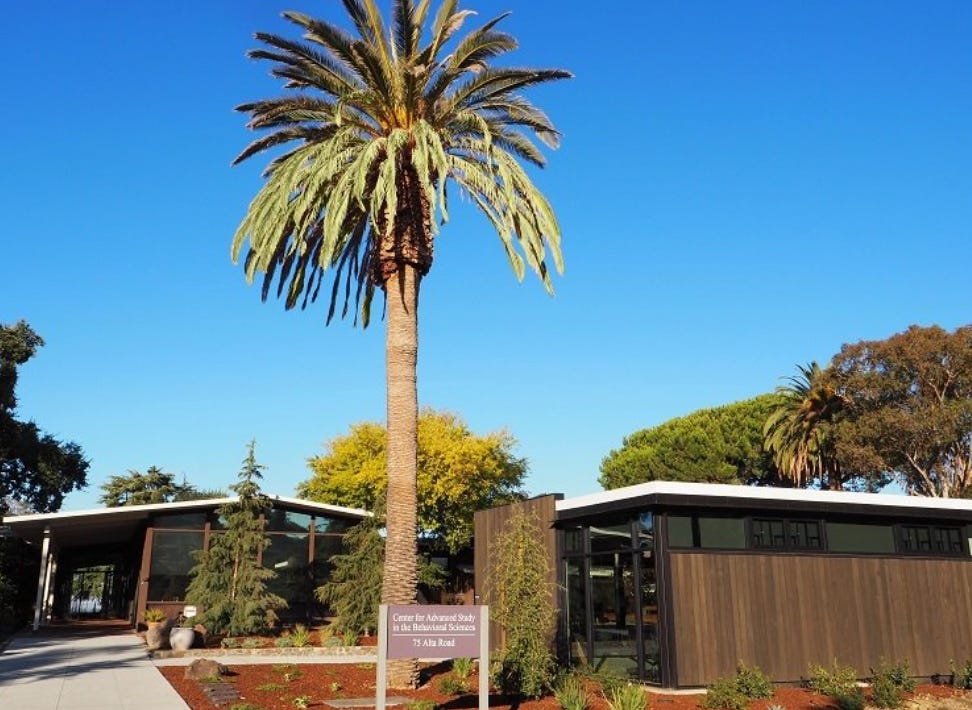
Entrance at the Center for Advanced Studies for Behavioral Sciences in Stanford.
(Next week, start of The Berkeley years),